
There is something satisfyingly contradictory about Houndstooth: familiar enough to feel classic, but jagged enough to resist becoming polite. The pattern’s broken edges give it an energy that a conventional check simply doesn’t have. More importantly, they give Houndstooth a remarkably resilient identity. Change the scale, colour, material or context and it still reads unmistakably as itself. That adaptability is a large part of its enduring appeal.
Houndstooth’s roots stretch much further back than the tailored coats and suits with which we tend to associate it today. The Gerum cloak, found in a Swedish peat bog and dated to around 360–100 BC, is one of the best-known surviving early examples of the motif, woven in naturally coloured wool in a pattern the Swedish History Museum identifies as Houndstooth.
But longevity alone is not what makes the pattern interesting. Its real strength lies in how easily it has moved between different uses and settings. By the 18th and 19th centuries, Houndstooth had become part of the language of British woollens and tailoring, particularly in Scotland, where broken checks had long featured in weaving traditions. What began as practical cloth was increasingly finding a place in fashionable dress.


By the middle of the 20th century, Houndstooth was firmly embedded in tailoring and couture, carrying associations of polish, structure and precision. In a post-war fashion world preoccupied with silhouette, cut and construction, it felt entirely at home. Paris couture was at its height, while London was celebrated for the rigour of its tailoring. Those associations strengthened Houndstooth’s visual identity, but also gave later designers something to challenge and push against.
Few did so more memorably than Alexander McQueen. In The Horn of Plenty for Autumn/Winter 2009, he took Houndstooth’s associations with tailoring and couture and exaggerated them to dramatic scale, stretching its familiar geometry into something sharper, stranger and more theatrical. The pattern did not disappear in the process. If anything, its recognisability made the transformation more powerful.


The move from wardrobe to room is not as great a leap as it first appears. Tailoring and upholstery both depend on the relationship between cloth and form. In each, fabric does more than decorate: it defines line, adds structure and changes the character of what it covers.
There are material parallels too. In both tailoring and upholstery, the way cloth behaves matters: how it holds a line, how it falls and how it responds to use.
Houndstooth is especially well suited to that transition. In clothing, it can feel crisp and precise. On furniture, the same broken geometry becomes more expansive and architectural. A motif associated with jackets and coats suddenly has room to stretch.
Our own Houndstooth takes its cue from a January 1959 cover of the British edition of Harper’s Bazaar, photographed by Richard Dormer and featuring Houndstooth tailoring. The cover is one of six archive references behind the collaborative FRAME fabrics, each reconsidered through scale, colour and repeat for upholstery.


For FRAME, Houndstooth appears in two distinct expressions: printed on velvet and woven in wool. On velvet, the print gives the motif a cleaner, more immediate definition. The woven version takes the tailoring connection further, bringing greater depth, structure and texture.


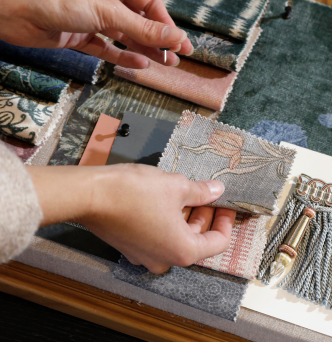
To develop it, we worked with Abraham Moon in Yorkshire, whose experience spans cloth for both apparel and interiors. Andrew Cussins and the Moon team began with classic fashion and tailoring references, including Coco Chanel, and explored how that familiar language could be translated from apparel into upholstery.
That translation involved more than simply enlarging the pattern. Apparel fabrics are generally woven more loosely to allow for drape, so the construction was made more compact for upholstery, with yarns selected specifically for furnishing use. The Houndstooth was also adapted in scale, allowing it to retain its graphic clarity and tailoring character while gaining the substance and structure required for furniture.
The coordinating Woven Check takes a different approach again. Bouclé and slub-effect yarns give the weave a more textured, multicoloured tweed character, creating a companion fabric that shares the same tailoring vocabulary without simply repeating the Houndstooth.
Together, they show what happens when a familiar fashion language is reconsidered through the requirements of upholstery: scale shifts, construction changes and texture comes further to the fore, while the original reference remains recognisable.


Then there is colour.
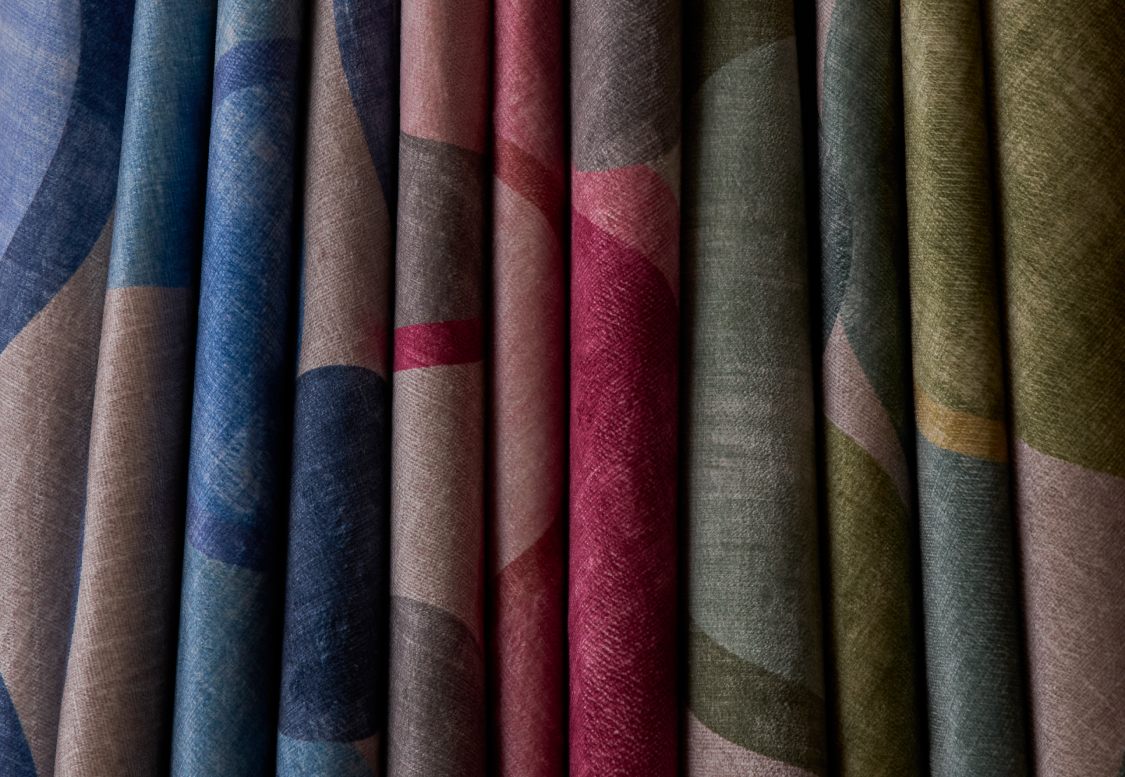
For all Houndstooth’s associations with black and white, colour changes its temperament. Deep brown can make it richer and more urbane. Green can soften some of its severity. In Shocking Pink, the familiar geometry becomes exuberant, even a little provocative.
Harper’s Bazaar Features Editor Charlotte Brook carried that spirit forward, styling Aspect in Shocking Pink Woven Houndstooth and coordinating Woven Check with references drawn from fashion and tailoring. Her instinct was not to temper the pattern, but to follow its confidence.
“A pattern endures when it’s graphic and bold and not shy,” she says.
In the finished room, Houndstooth takes on a different character across Aspect’s high back and horizontal channels, alongside the coordinating Check. The scale of the sofa gives the pattern greater presence, while Shocking Pink pushes it somewhere more expressive. As Charlotte puts it, “Using a historic fabric on contemporary shapes I think is rather an exciting crossover.”
What endures is Houndstooth’s recognisability. It can move between fashion and interiors, print and weave, restraint and exuberance, without losing the graphic identity that makes it unmistakably itself.
That may be its real strength. Houndstooth has lasted not because it has resisted change, but because generation after generation has found a new way to give it fresh expression.


